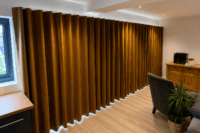
Best Blinds for Bay Windows
What Blinds Are Best for Bay Windows?
Bay windows are a popular feature in many homes, bringing in extra light and adding character to a room. However, they also require a different approach when it comes to choosing the right window coverings.
Unlike standard flat windows, bay windows project outward and change direction. This means they are not suited to having a single blind fitted across the front. Instead, the most successful solutions are those that follow the shape of the bay, allowing each section of the window to function properly while maintaining balance and proportion.
The best blinds for bay windows depend on several factors, including the shape of the bay, the depth of the window recess and how the room is used. Some window coverings work well in certain types of bay windows but are unsuitable in others.
This guide explains the different bay window types and the blinds, curtains and shutters that tend to work best with them, helping you make an informed decision based on practicality as well as appearance.
Types of Bay Windows
Bay windows come in several different shapes and the type of bay you have will influence which blinds, curtains or shutters will work best. Understanding your bay window layout is an important first step before considering specific window covering options.
Curved Bay Windows
Curved bay windows form a smooth, continuous arc rather than having defined angles. They are commonly found in older or period properties and usually require shaped or bespoke solutions.
Because the window doesn’t have straight sections, rigid or flat systems are rarely suitable. Window coverings that can follow the curve, such as curtains on a shaped track or curved vertical blinds, tend to work best.
Splay Bay Windows
Splay bay windows are the most common type found in UK homes. They feature angled side windows that project outward from the room, usually with a flat front window.
Each section of the bay needs to be considered individually, particularly if you’re fitting blinds or shutters within the window recess. The angles and depth of the recess can vary, so careful planning is important to ensure a neat and balanced finish.
Square Bay Windows
Square bay windows project outward with straight sides and a flat front, creating a box-like shape. While this might appear simpler, square bays can be one of the more challenging bay types when it comes to fitting blinds.
The sharp corners leave little tolerance for error, and if blinds are not measured and planned carefully, gaps can appear between sections. These gaps may seem minor but can affect both privacy and light control, particularly in the evenings when interior lights are on.
Certain blind systems can also clash at the corners if allowances are not made for headrails, controls and fixings. Because of this, not all blind types are suitable for square bays, and accurate measuring is essential to achieve a neat, private and functional finish.
Hockey Stick Bay Windows
Hockey stick bay windows combine a bay window with a return into a straight run of window or wall. They are often found at the front of properties where the bay flows into a standard window section.
These bays require thoughtful planning to ensure window coverings don’t clash at the return point and that the overall look feels cohesive across both the bay and the straight section.
Bespoke or Irregular Bay Windows
Some bay windows don’t fit neatly into standard categories. These may have uneven angles, varying depths or architectural quirks, often found in older homes or properties that have been extended.
In these cases, off-the-shelf solutions rarely work well. Window coverings usually need to be planned specifically around the shape of the bay to achieve a practical and well-finished result.
Roman Blinds – Soft Style That Follows the Bay
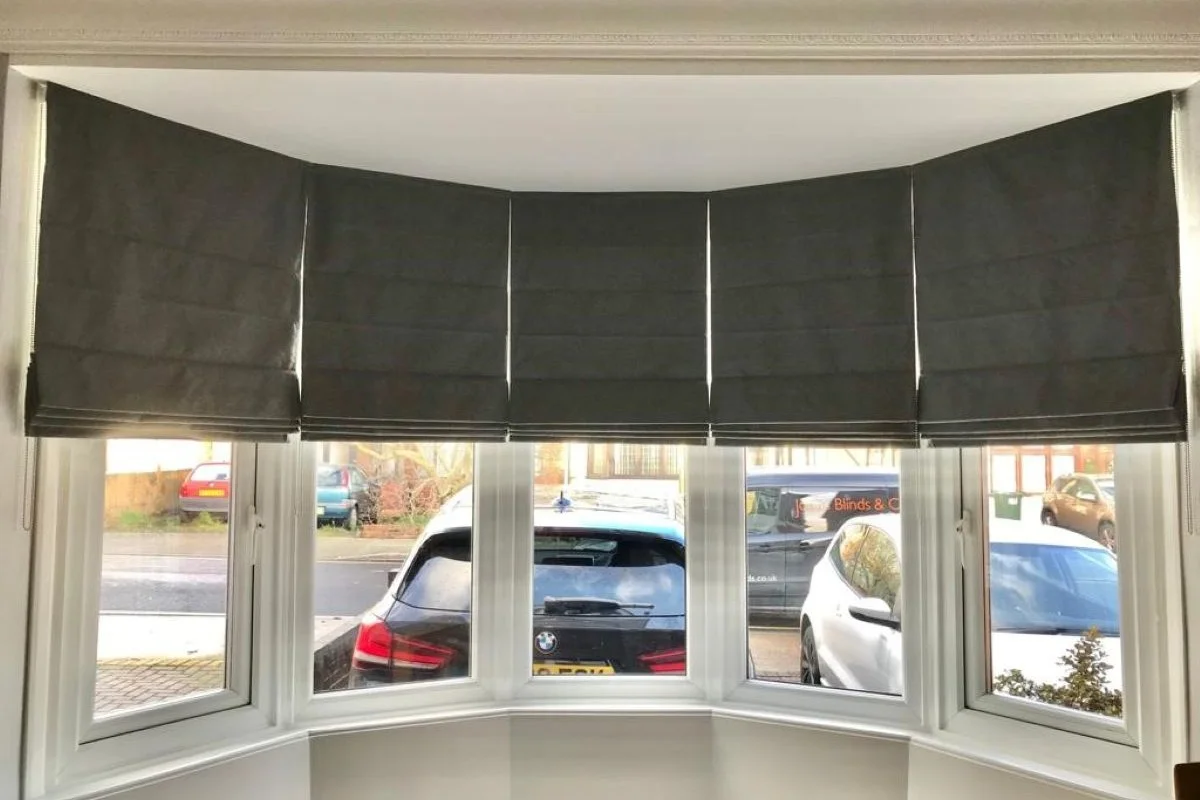
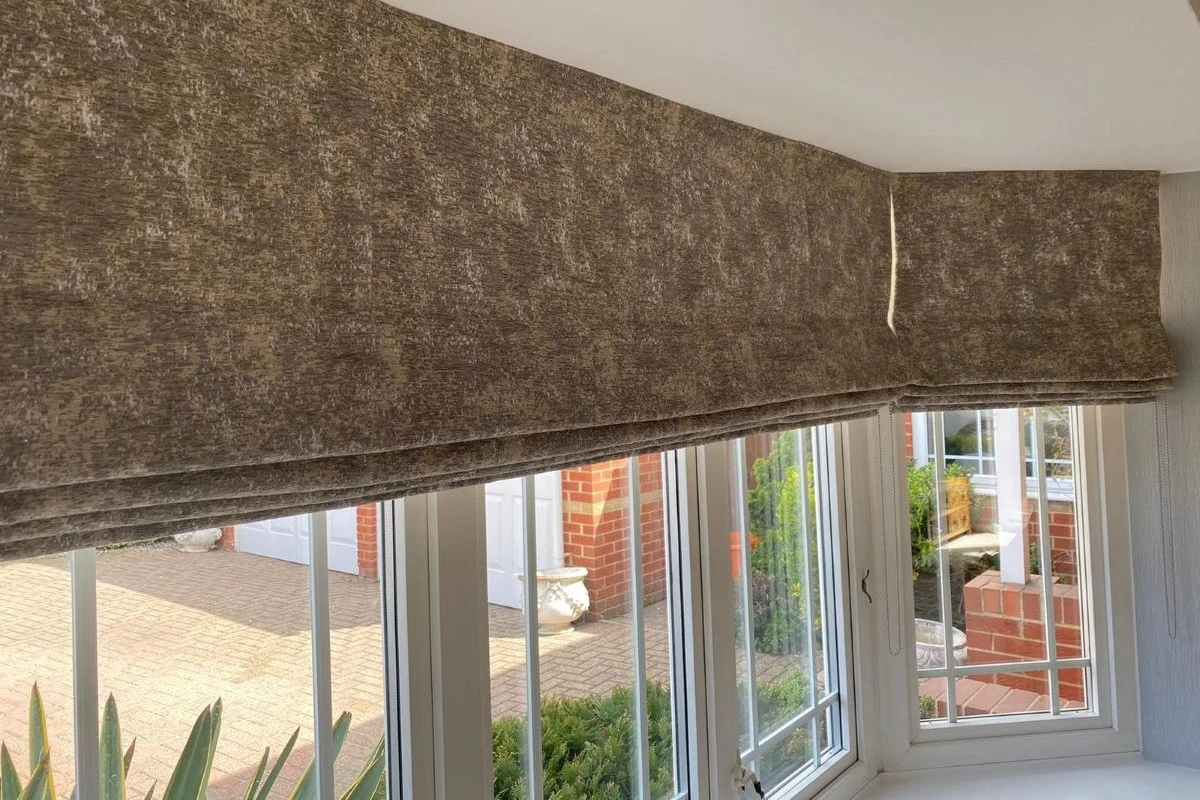
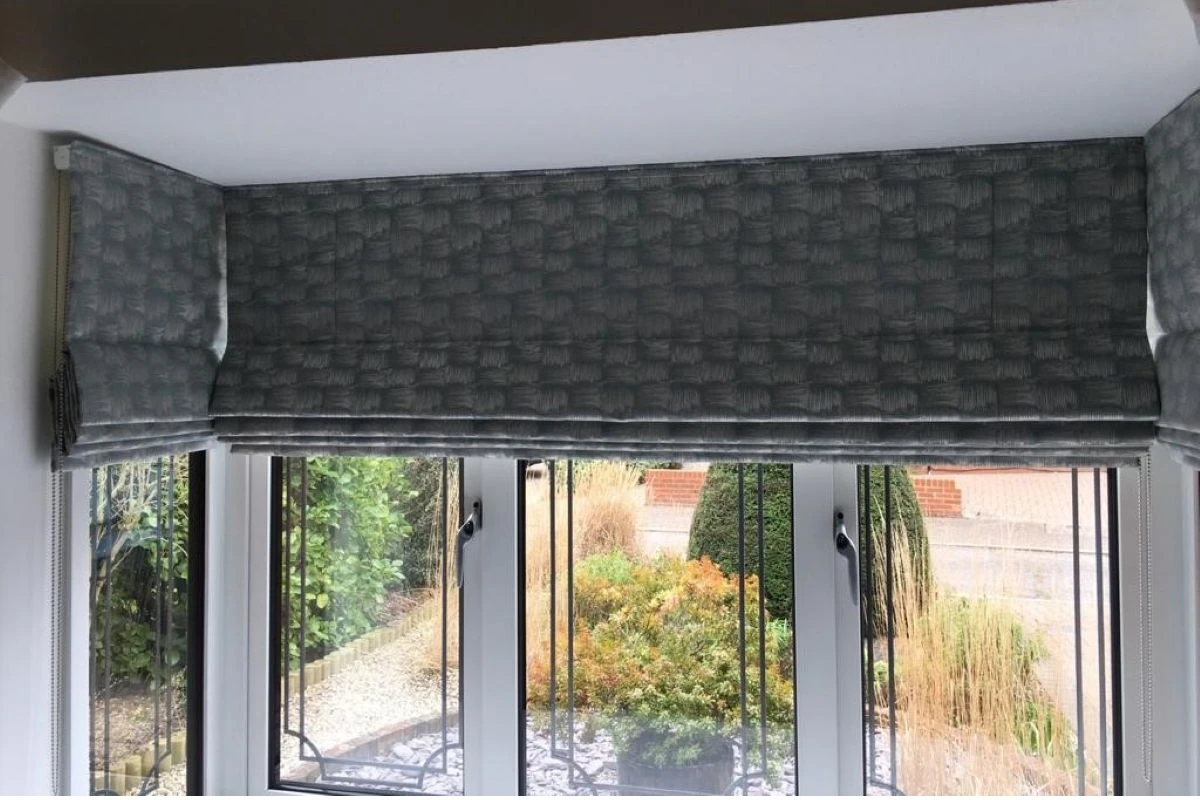
Roman blinds are a popular choice for bay windows where a softer, more decorative finish is preferred. When fitted individually to each section of the bay, Roman blinds allow the shape of the window to flow naturally, rather than flattening or cutting across it.
They work particularly well in living rooms and bedrooms, adding warmth and texture while still providing practical light control. Because Roman blinds stack neatly when raised, they help maintain the openness of the bay during the day, while offering privacy and comfort in the evening.
Careful planning is important, especially in tighter bays, to ensure the blinds operate independently without clashing at the corners.
Works Well for Bay Windows Where:
You want a softer, more decorative look
The bay is made up of individual window sections
Maintaining the shape of the bay is important
Curtains may feel too heavy or intrusive
Light control and privacy are needed without a rigid appearance
Strengths:
Softens the bay window beautifully
Works well when fitted to individual panes
Available with lining options for light control and insulation
Pairs well with curtains for a layered look
Suitable for both traditional and modern interiors
Limitations:
When raised, Roman blinds expose the window, which can reduce privacy in front-facing bay windows
Less suitable where daytime privacy is a priority
Not ideal for very shallow recesses
Requires careful measuring to avoid corner clashes
Not suitable for all bay window types, particularly where angles are tight or irregular

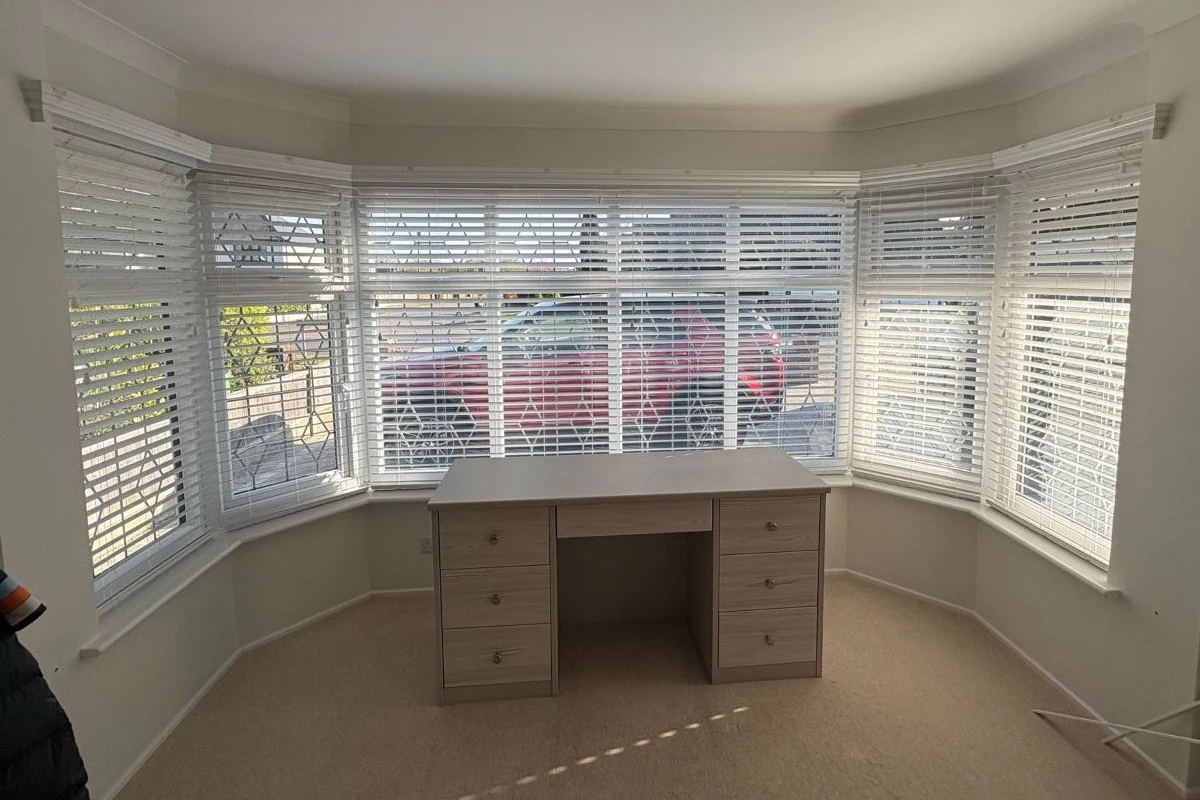
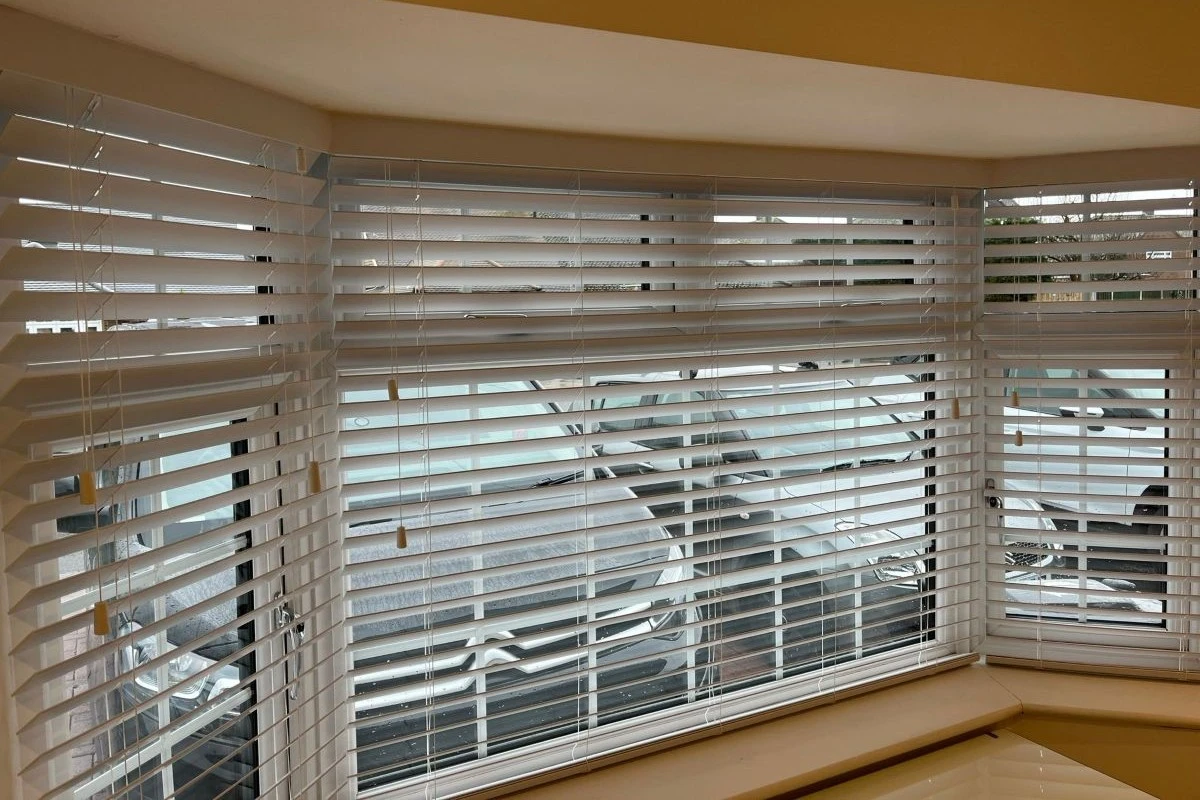
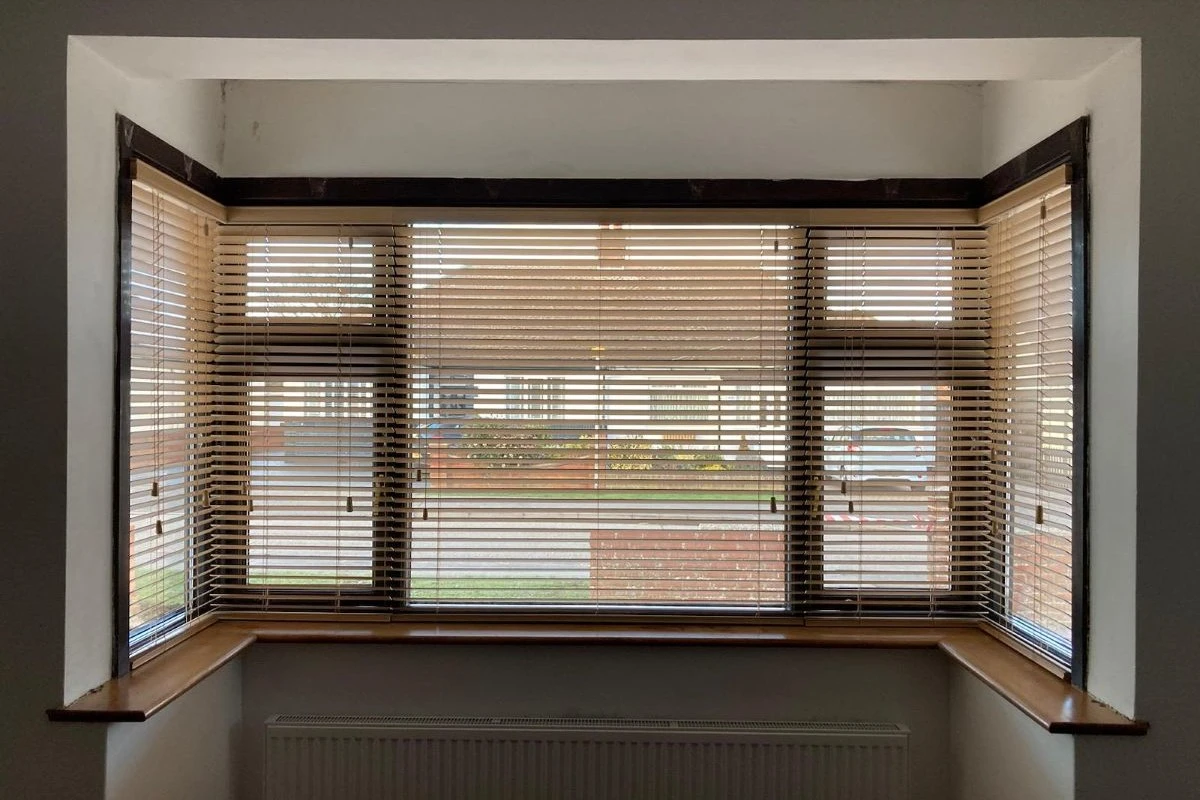
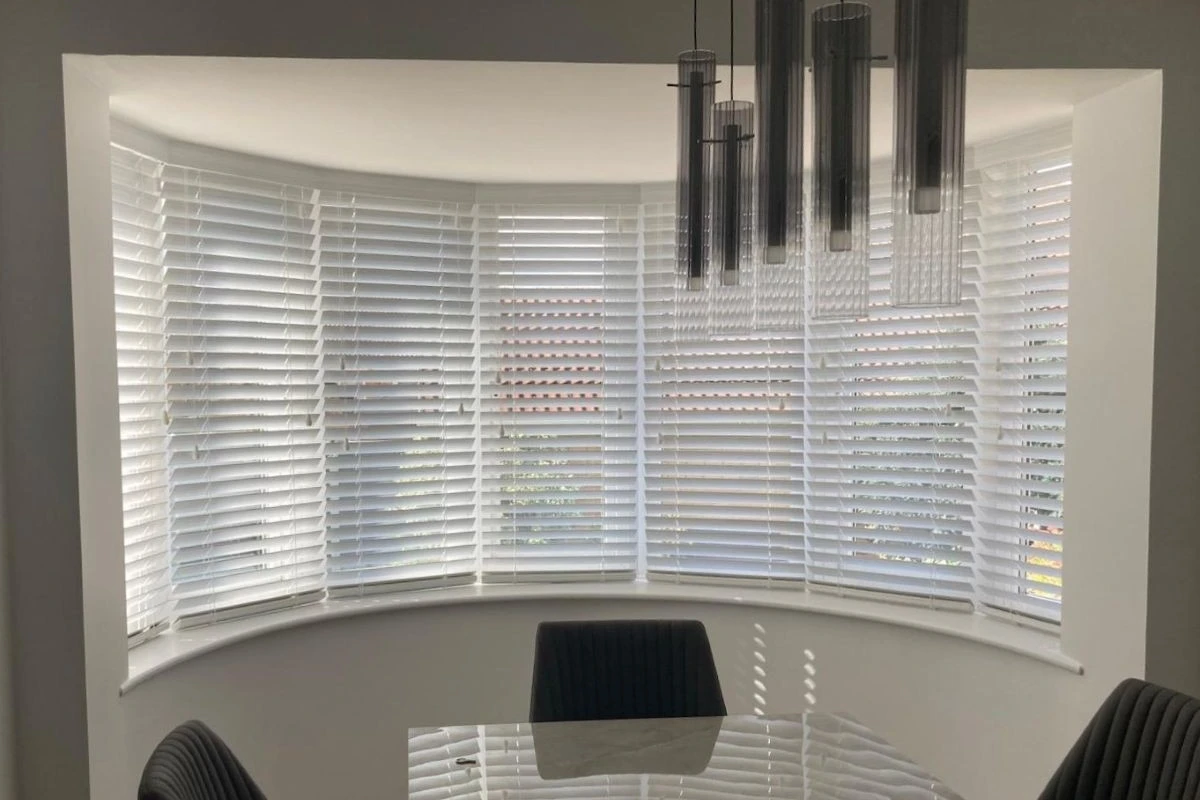
Venetian Blinds – Flexible Light Control for Angled Bay Windows
Venetian blinds are a practical and versatile option for many bay windows, particularly where precise light control and privacy are important.
Their adjustable slats allow you to control sunlight throughout the day without fully raising the blind, which is especially useful in front-facing bays or rooms overlooked by neighbouring properties.
Venetians blinds can be fitted neatly within each section of a bay window, allowing the blinds to follow the shape of the bay rather than cutting across it. This makes them suitable for splay bays, square bays and some curved bays, depending on the window layout and fixing depth.
Venetian blinds are often a strong middle ground for bay windows – more flexible than many fabric blinds, yet more structured than soft window dressings.
When measured and fitted correctly, they can deliver excellent day-to-day comfort and control.
Works Well in Bay Windows Where:
The bay has angled or straight sections rather than a continuous curve
You want control over glare without blocking natural light
Privacy is needed during the day without fully closing the window covering
A clean, structured look suits the room
The bay window is used daily and needs a practical solution
Strengths:
Excellent control of light and privacy
Suitable for many splay and square bay windows
Can be fitted neatly within individual bay sections
Available in a wide range of colours and finishes
Durable and easy to maintain
Limitations:
Slats stack at the top when fully raised, which reduces the visible glass area
Not suitable for all curved bay windows
Larger or heavier slats require accurate measuring and careful fitting
Can feel more functional than decorative unless layered with curtains
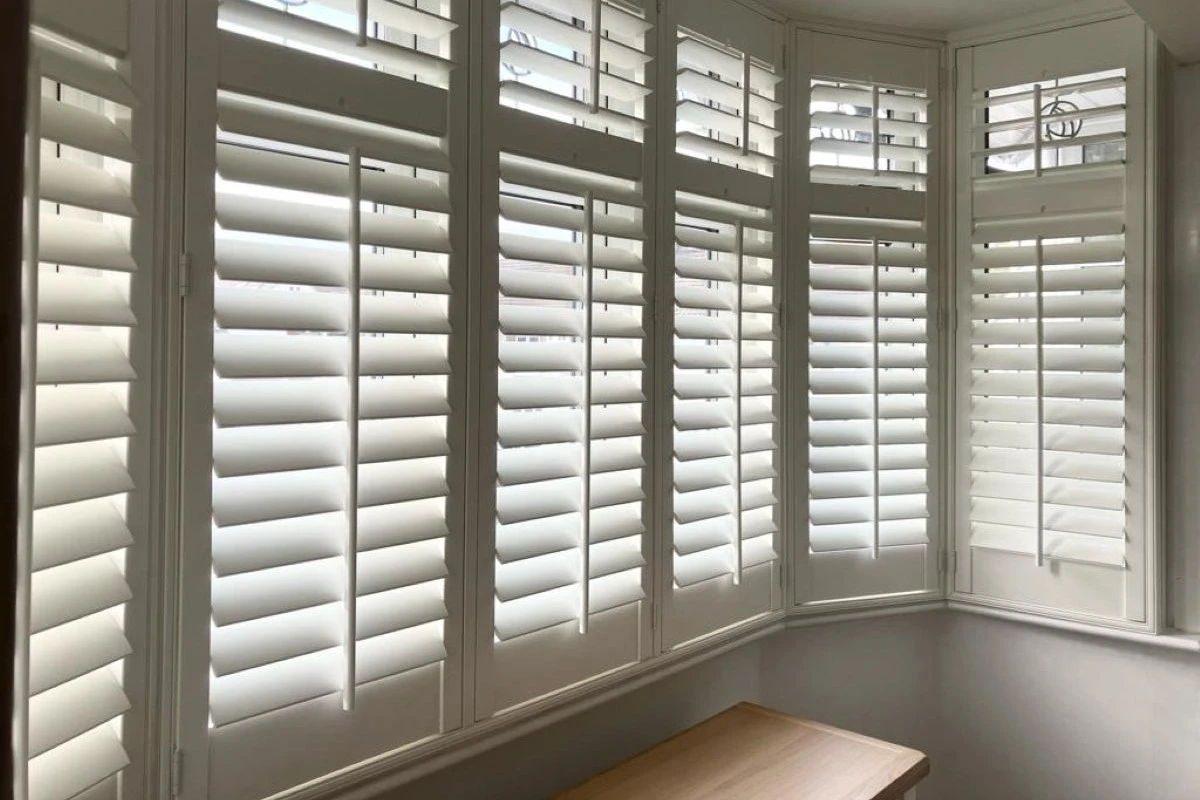
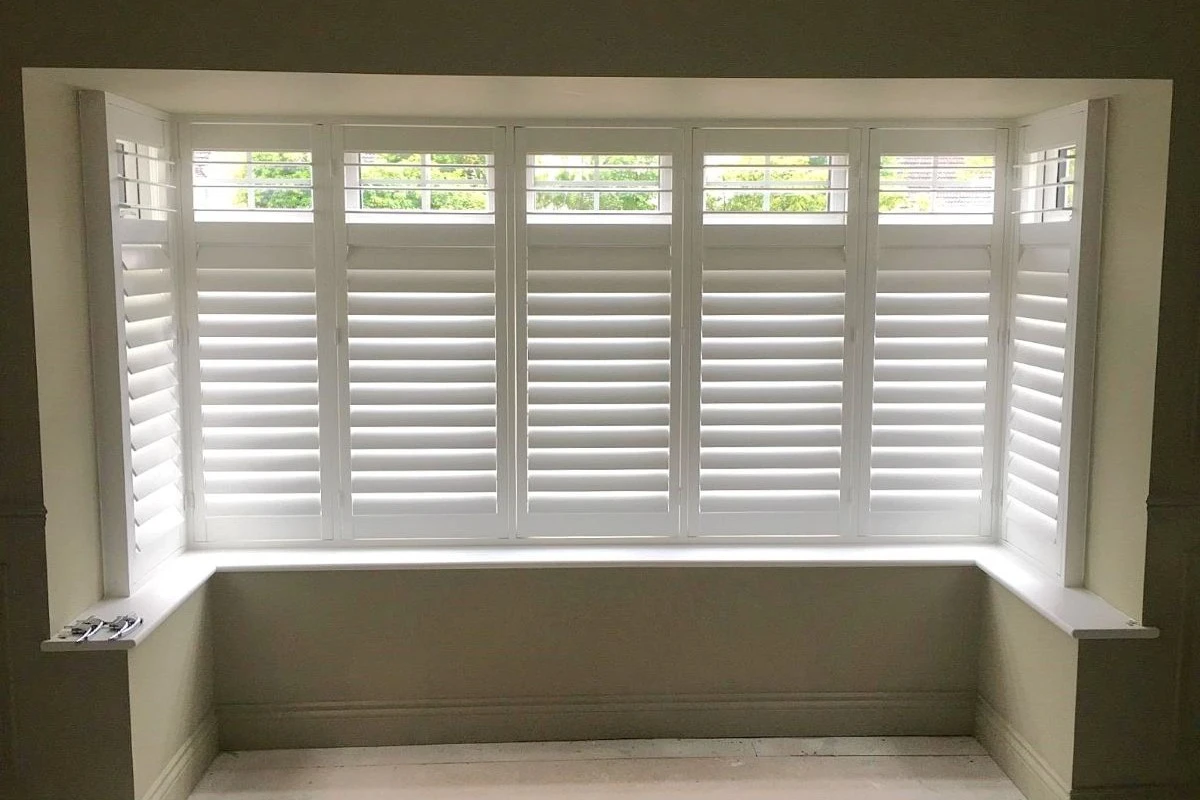
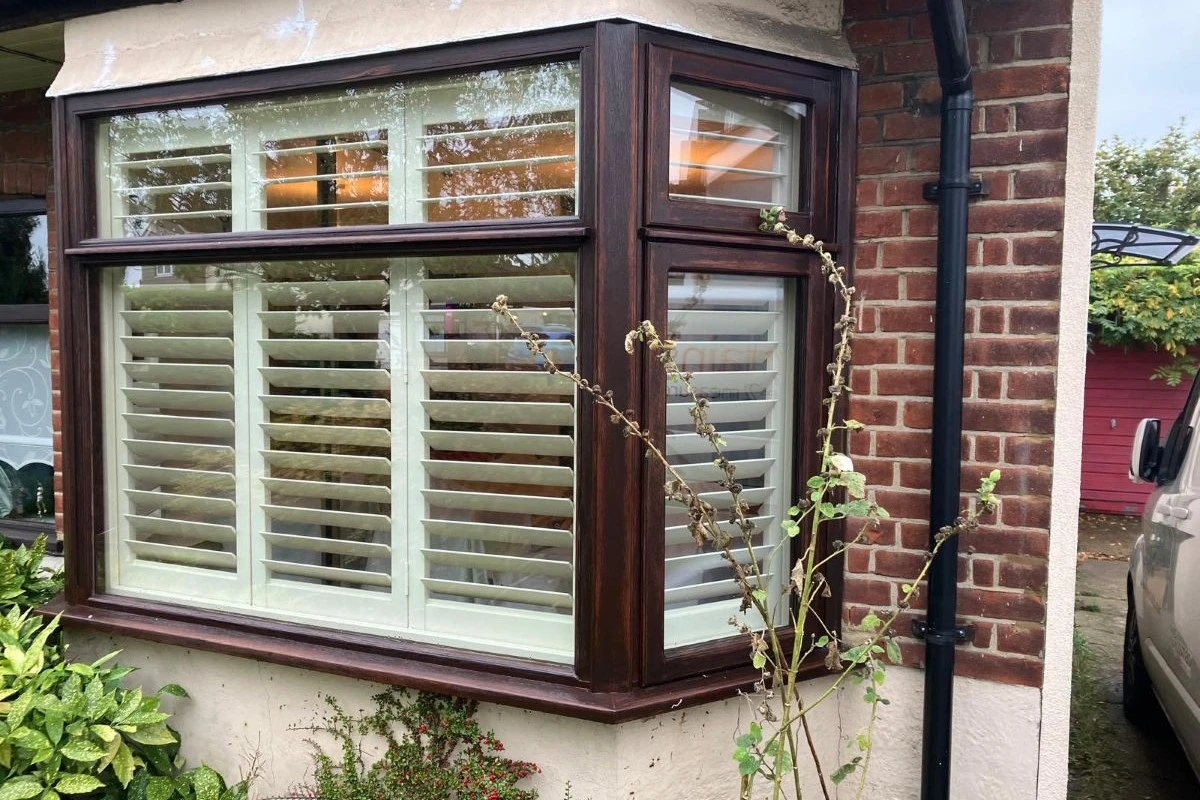
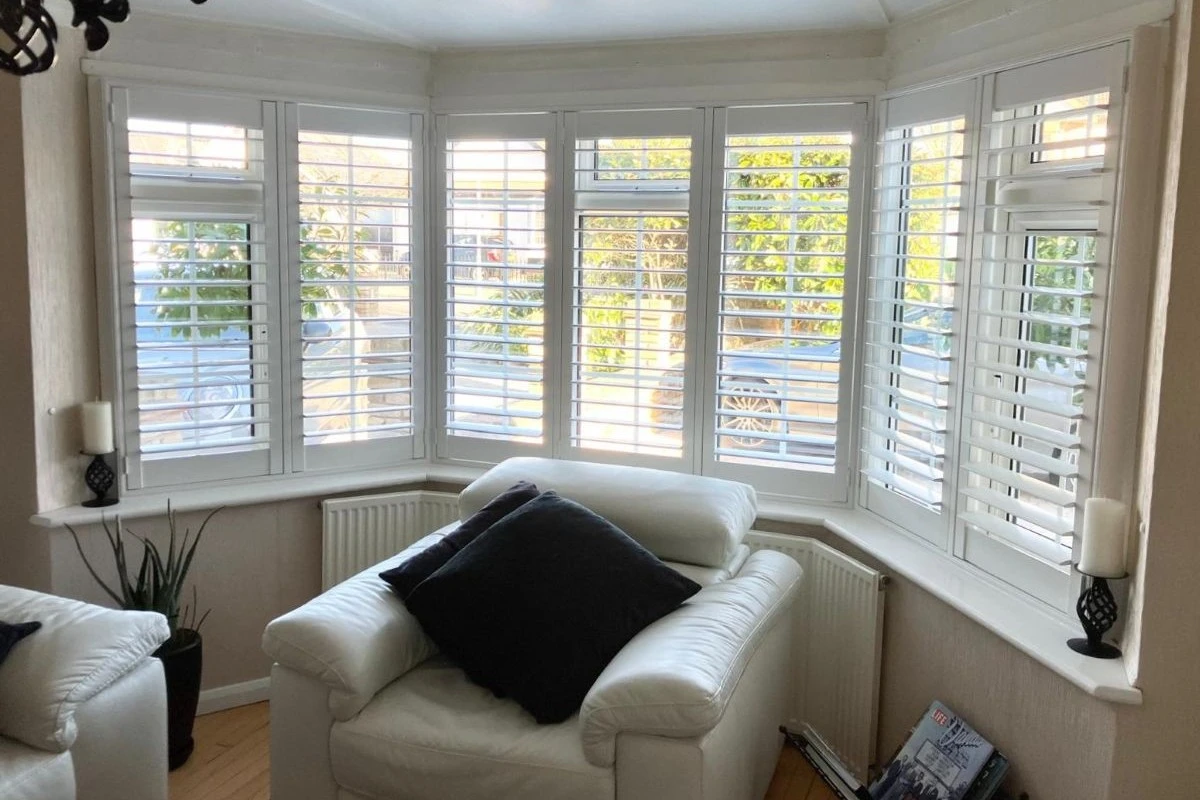
Plantation Shutters – Tailored Solutions for Bay Windows
Plantation shutters are one of the most effective and visually striking options for bay windows. Because they are made to measure, shutters are designed to follow the angles or curves of the bay rather than cutting across it, preserving the shape of the window.
Their adjustable louvres allow you to control privacy and daylight independently, which is particularly useful in front-facing bay windows. You can maintain privacy at street level while still allowing natural light into the room, without needing to fully open or close the shutters.
Plantation shutters work well across many bay window types, including splay bays, square bays and curved bays, provided they are measured and planned correctly. In more complex bays, careful consideration of panel layout and hinge positions is essential to ensure smooth operation and a neat finish.
While shutters provide a strong architectural look on their own, they can also be layered with curtains to soften the overall appearance and add warmth to the space.
Works Well In Bay Windows Where:
The bay window faces the street or neighbouring properties
Privacy is needed without blocking daylight
A clean, tailored finish is preferred
The shape of the bay should remain visible
Long-term durability and low maintenance are important
Shutters are layered with curtains to soften the look and add warmth
Strengths:
Designed to follow the shape of the bay window
Excellent control of light and privacy
Particularly effective in square and splay bay windows
Adds structure and definition to the room
Durable and easy to maintain
Can improve comfort by reducing glare and draughts
Limitations:
Higher investment compared to most blinds
Requires accurate measuring and professional fitting
Can appear quite structured if not softened with curtains
Not suitable where total blackout is required unless Shutter & Shade
- Panel layouts and hinge positions need careful planning in tighter or more complex bay windows
Curtains – Softness, Flow and Flexibility for Bay Windows
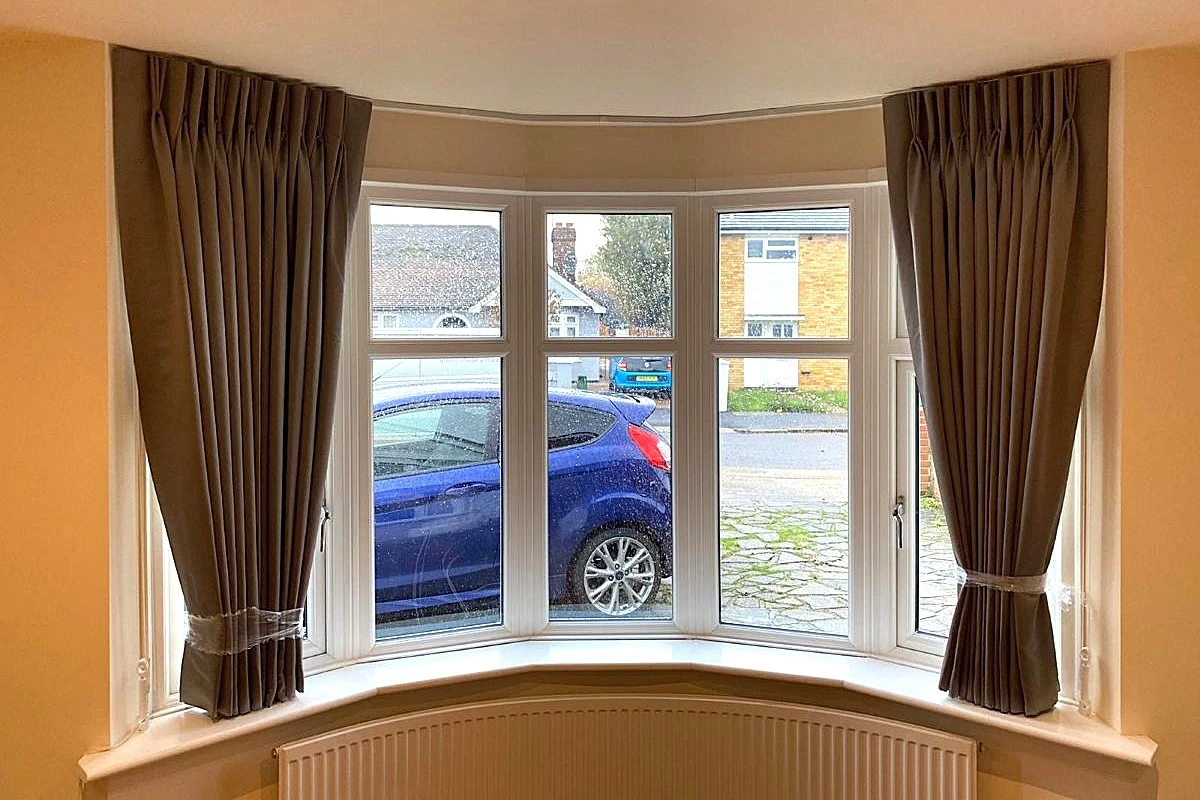
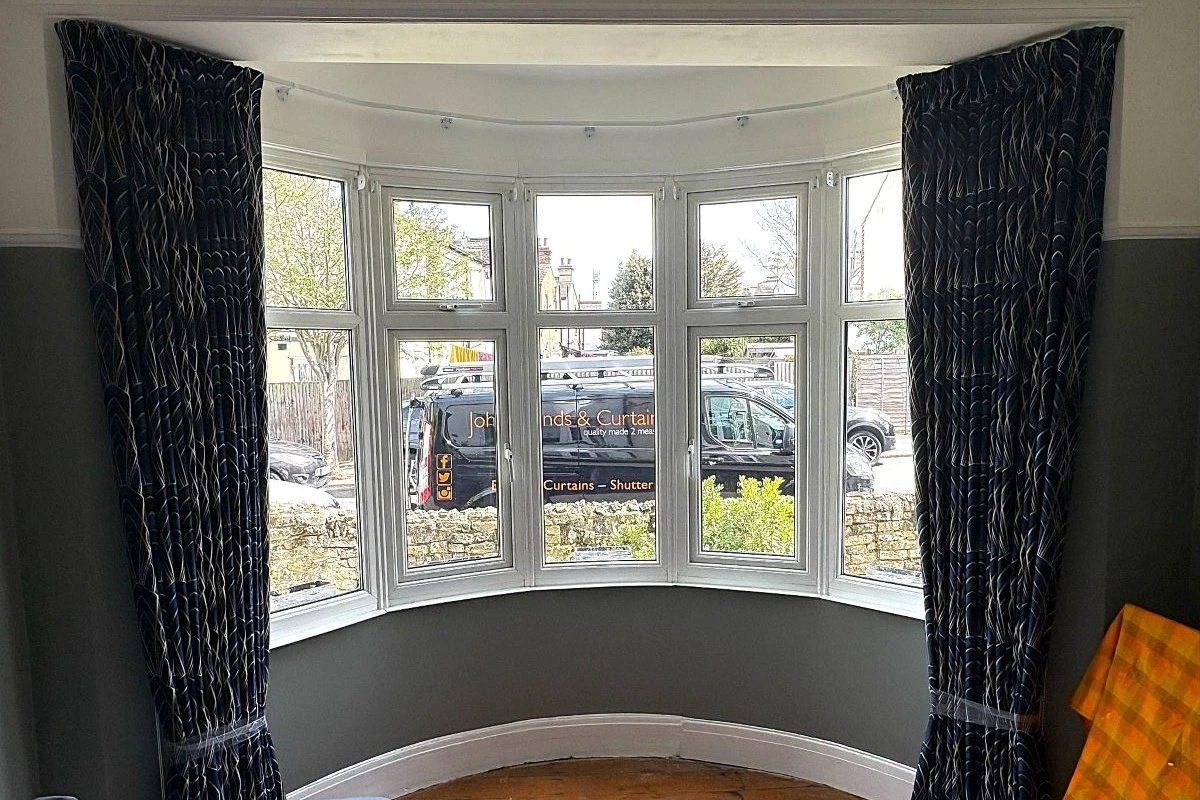
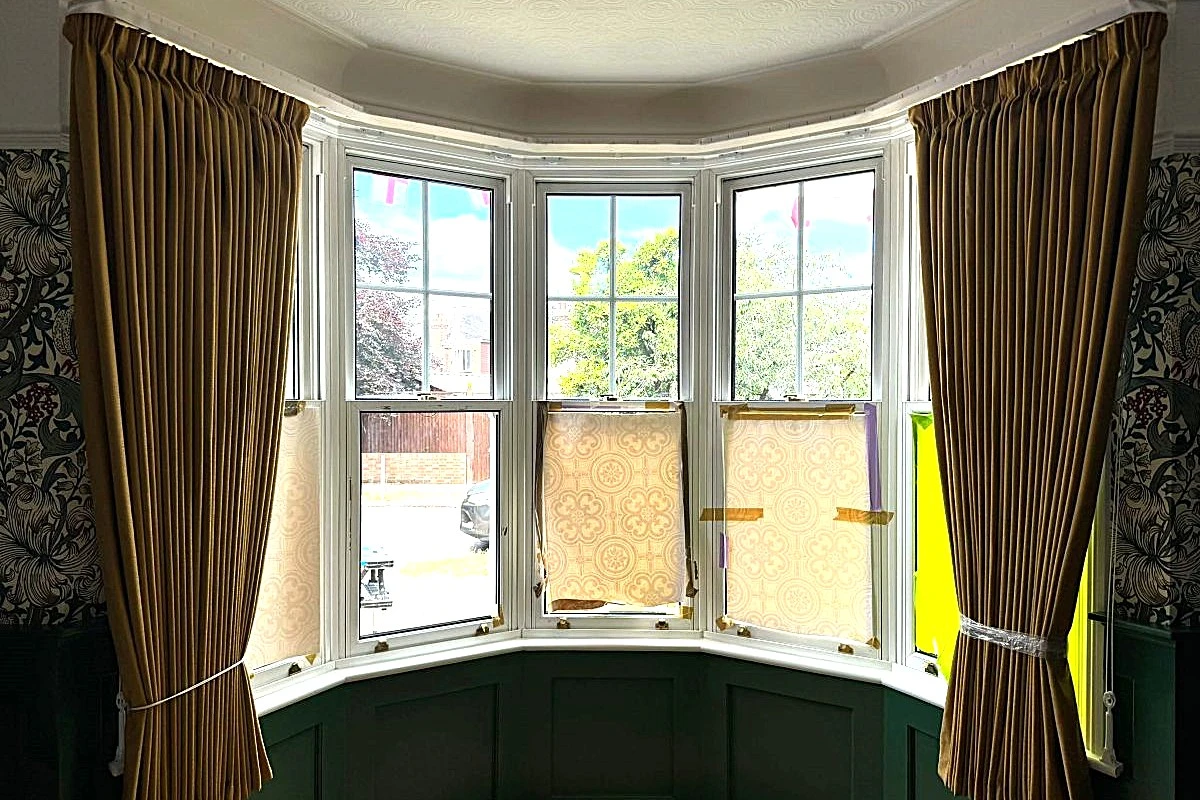
Curtains are one of the most versatile and forgiving window dressing options for bay windows, particularly when the aim is to enhance the shape of the bay rather than break it up. When planned correctly, curtains follow the bay smoothly and add warmth, softness and visual balance to the space.
Unlike blinds that are fitted within each window section, curtains are typically installed on a shaped or bay curtain track that flows around the angles or curve of the bay. This allows the fabric to move freely across the entire window, helping the bay feel cohesive rather than segmented.
Curtains work especially well in living rooms, bedrooms and dining spaces where comfort, acoustics and style are just as important as light control. Tailor-made curtains are often the finishing layer that completes a bay window, even when another window covering is doing the practical work underneath.
Curtain Headings, Tracks and Poles in Bay Windows
The curtain heading and how the curtains are supported play a crucial role in how well curtains work in a bay window.
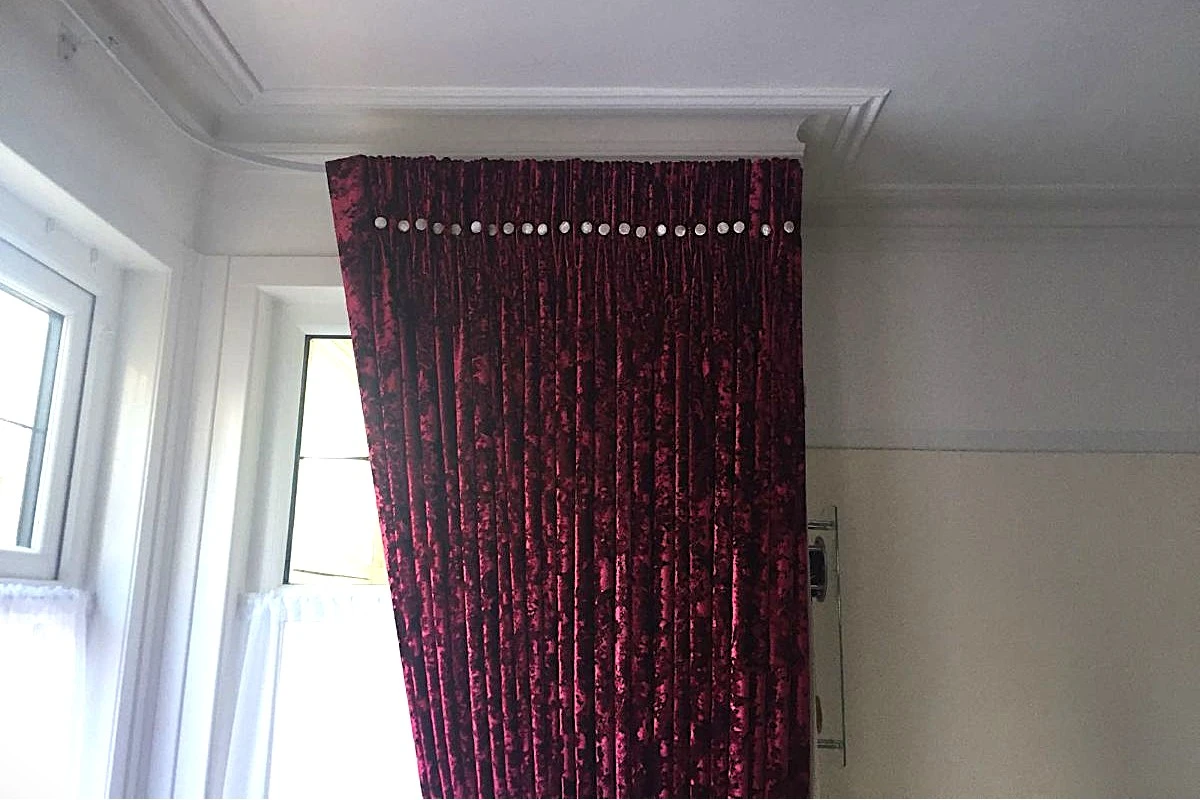
In most cases, curtain tracks are the preferred option. Tracks can be shaped to follow curves or angles, mitred neatly at corners and fixed close to the ceiling or within the bay recess. This allows curtains to move smoothly around the bay and stack back neatly when open.
Curtain poles are more limited in bay windows. Although specialist bay poles are available, they rely on joints or bends at corners, which can interrupt the movement of the curtain and affect how evenly it hangs.
Some curtain headings are more suitable for bay windows than others:
Pencil Pleat and Pinch Pleat Curtains
These are among the most reliable choices for bay windows. They work exceptionally well on shaped tracks, move smoothly around corners and stack neatly at the sides. They suit both traditional and contemporary interiors and are particularly forgiving in angled or curved bays.
Eyelet Curtains
Eyelet curtains are generally less suitable for bay windows. They require curtain poles rather than tracks, and even with specialist bay poles the eyelets can catch or hesitate at corners. This can make opening and closing awkward and affect how evenly the curtains hang.
Choosing the right combination of heading style and support system helps ensure curtains enhance the bay window rather than working against its shape.
Works Well in Bay Windows Where:
You want the bay to feel soft and unified rather than broken into sections
Added warmth, comfort or sound absorption would be beneficial
Privacy is important, particularly in the evenings
The bay has angles or curves that suit a flowing solution
Curtains will be layered with blinds or shutters for flexibility
Strengths:
Follow the shape of the bay smoothly using shaped or bespoke tracks
Add warmth, softness and a more luxurious feel to the room
Excellent for insulation and reducing draughts
Huge choice of fabrics, headings and lining options
Work beautifully layered with Roman blinds, Venetians or shutters
Suitable for curved, splay and irregular bay windows
Limitations:
Require accurate measuring and specialist track planning
Stack-back space needs to be considered at the sides of the bay
Can reduce usable sill space when fully open
Not always suitable where a very minimal or fitted look is preferred
- Not suitable for all bay window types
Curved Vertical Blinds – A Practical Solution for Certain Bay Windows
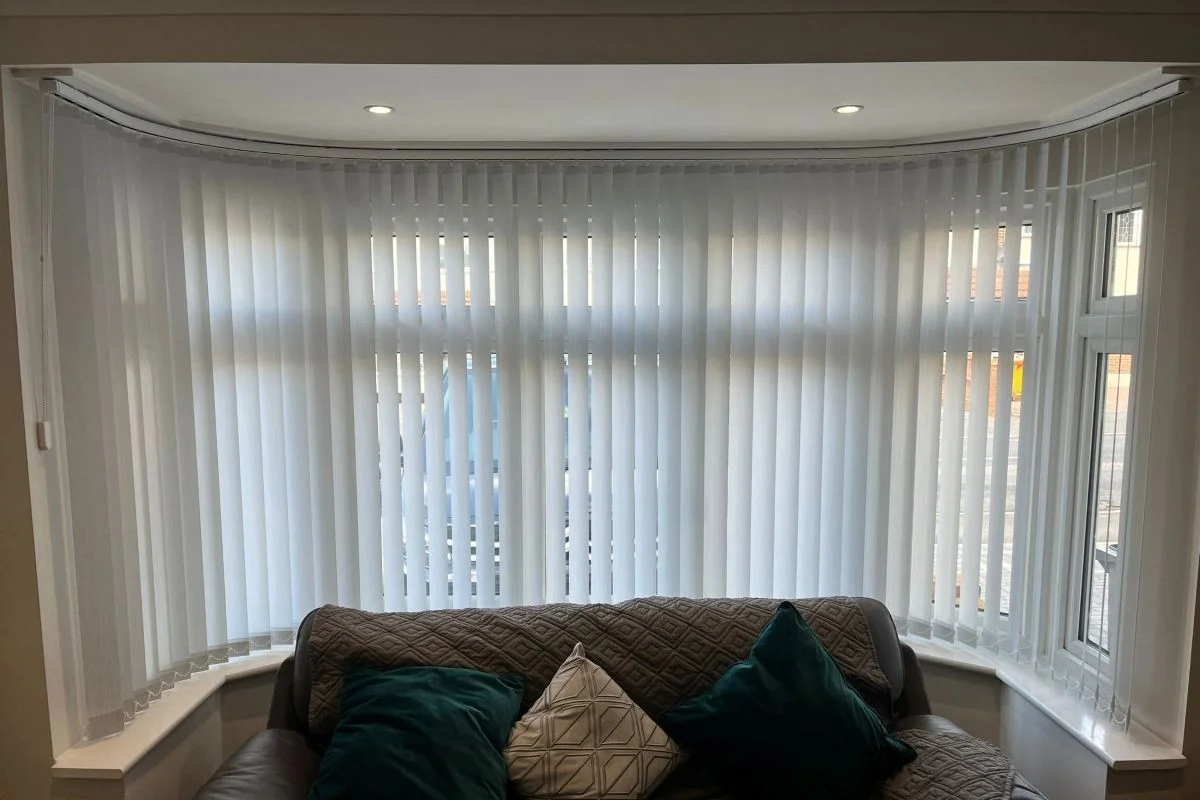
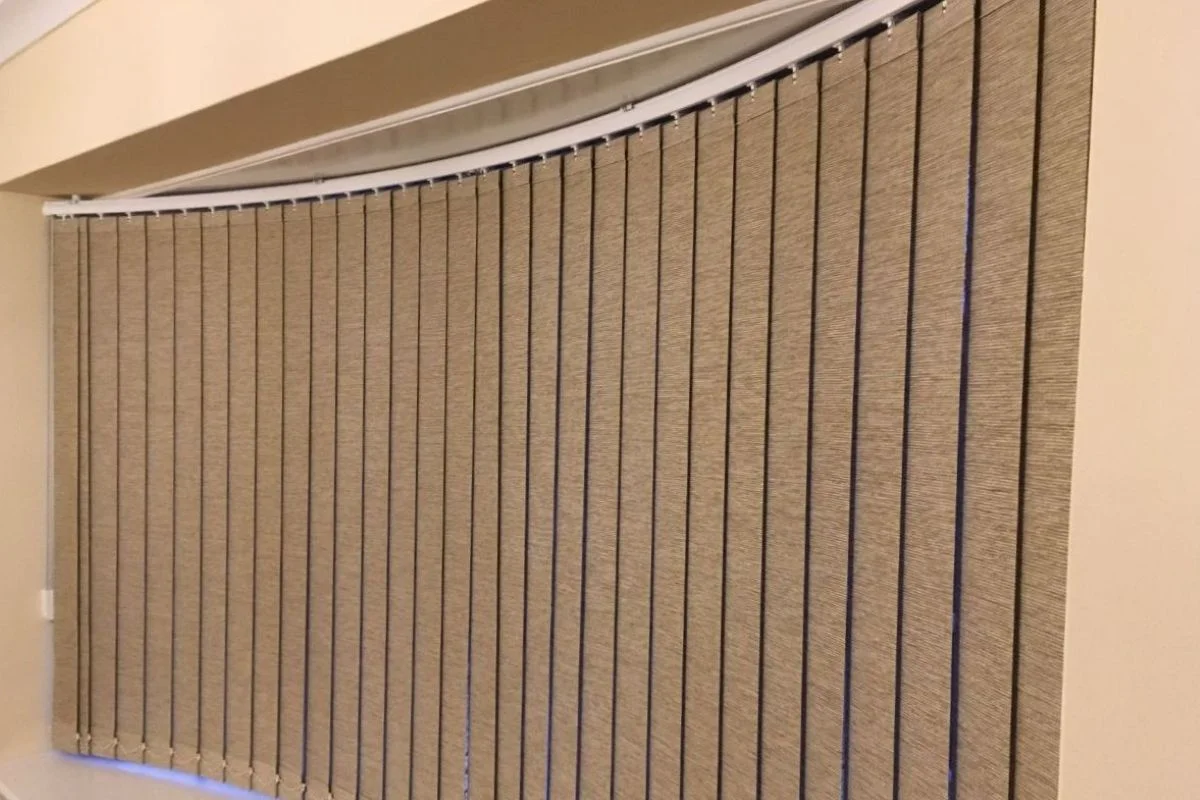
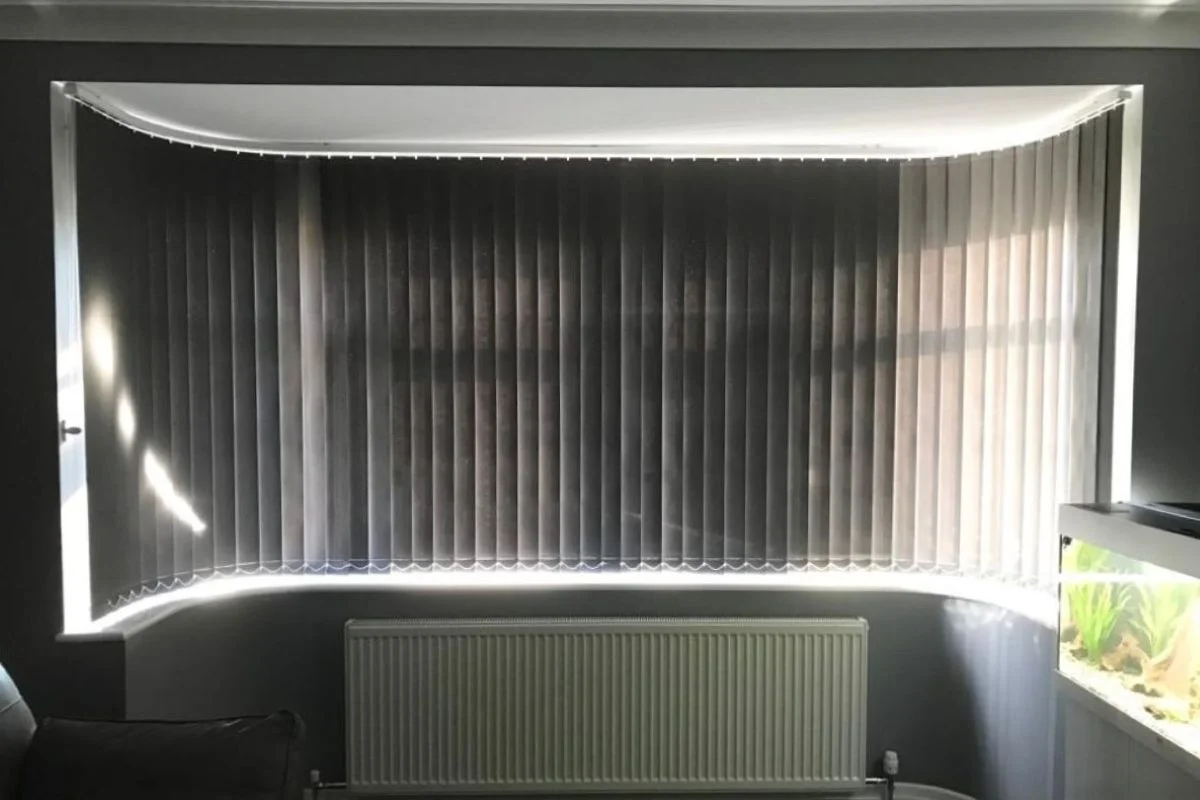
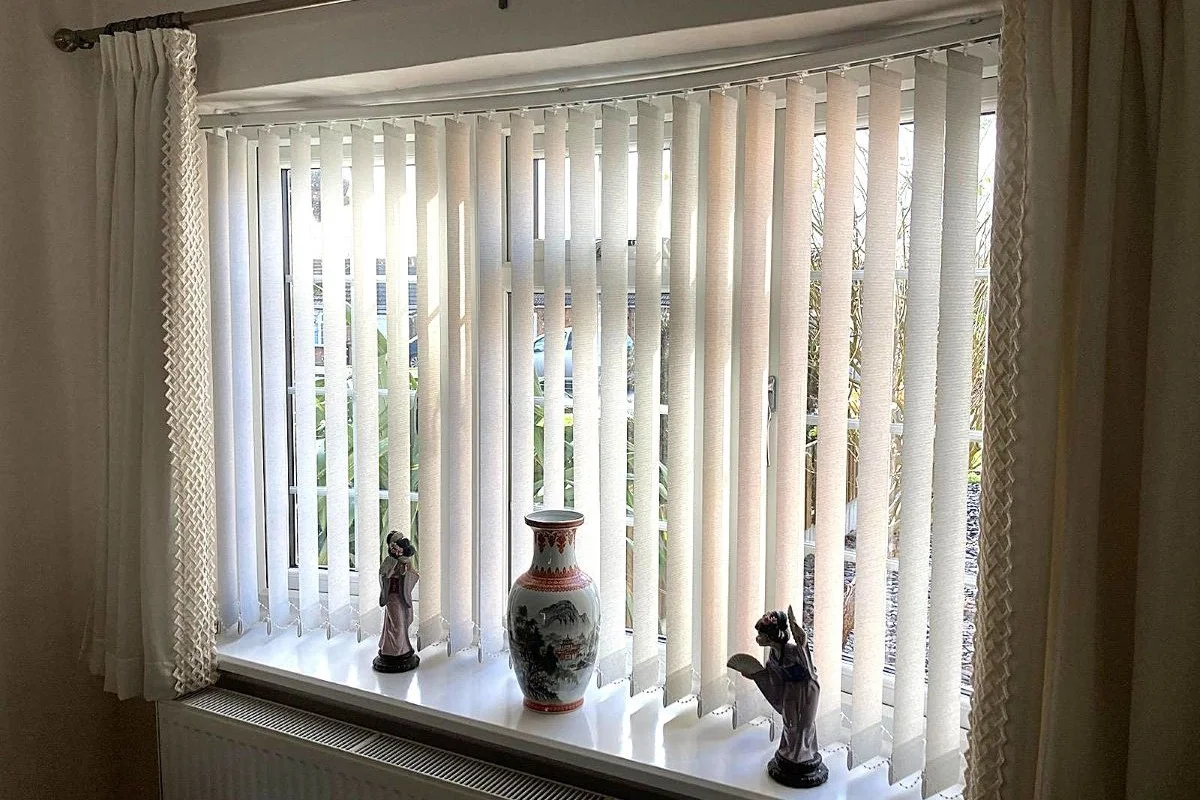
Curved vertical blinds are a specialist option that can work particularly well in curved bay windows or bays where other blind types struggle to follow the shape of the window.
Unlike standard vertical blinds, curved vertical systems are designed to follow a continuous arc, allowing the blind to sit neatly along the curve of the bay rather than breaking it into straight sections. This makes them one of the few blind types that can genuinely work in fully curved bays.
Curved vertical blinds are often chosen for their practicality rather than their decorative appeal. They offer effective light control across large glazed areas and allow individual louvres to be tilted or drawn back to one side, helping maintain views when required.
Curved vertical blinds are not for every bay window, but where the shape of the bay makes other solutions impractical, they can be an effective and reliable option.
Works Well In Bay Windows Where:
The bay window has a continuous curve
Other blind types cannot follow the window shape cleanly
Large glazed areas need managing as one unit
Practical light control is more important than a soft or decorative look
A simple, functional solution is preferred
- Splay or Hockey Stick bay windows
Strengths:
Designed specifically to follow curved bay windows
Effective light and glare control across wide window areas
Louvres can be tilted or drawn fully to one side
Suitable for living rooms, dining areas and larger spaces
More forgiving in bays where recess depth is limited
Limitations:
More functional than decorative in appearance
Less suitable for small or shallow bay windows
Fabric choices are more limited than curtains or Roman blinds
Not always the best option where a softer, more tailored look is desired
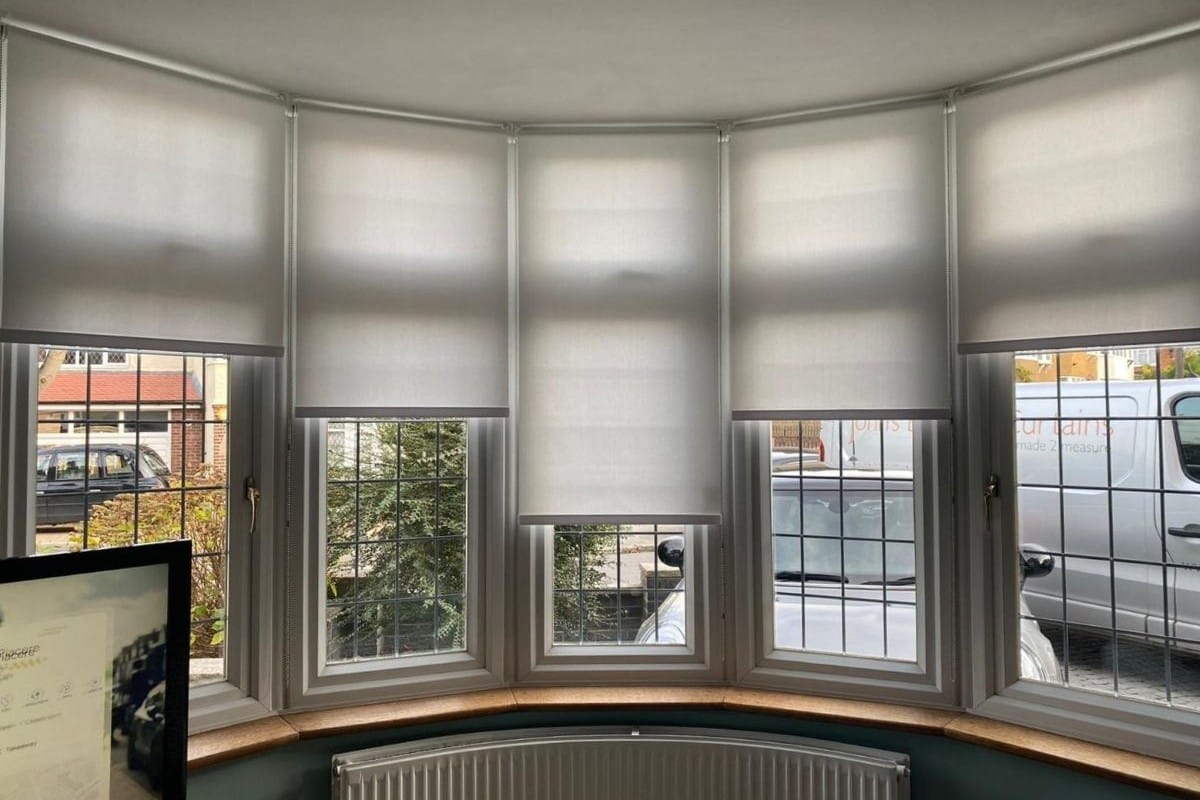
Roller Blinds
Roller blinds can work in bay windows when fitted individually to each window section, rather than across the bay as a whole. They offer a clean, minimal look and are available in a wide range of fabrics.
However, in tighter or more angular bays, roller blind mechanisms can clash at the corners if not planned carefully, and gaps between blinds may affect privacy.
Strengths
Simple, uncluttered appearance
Available in blackout, light-filtering and sunscreen fabrics
Can work well on individual panes in splay or square bays
Suitable for modern interiors
Limitations:
Mechanisms can clash at corners if not carefully planned
Gaps between blinds may affect privacy
Less forgiving in tight, angular or irregular bays
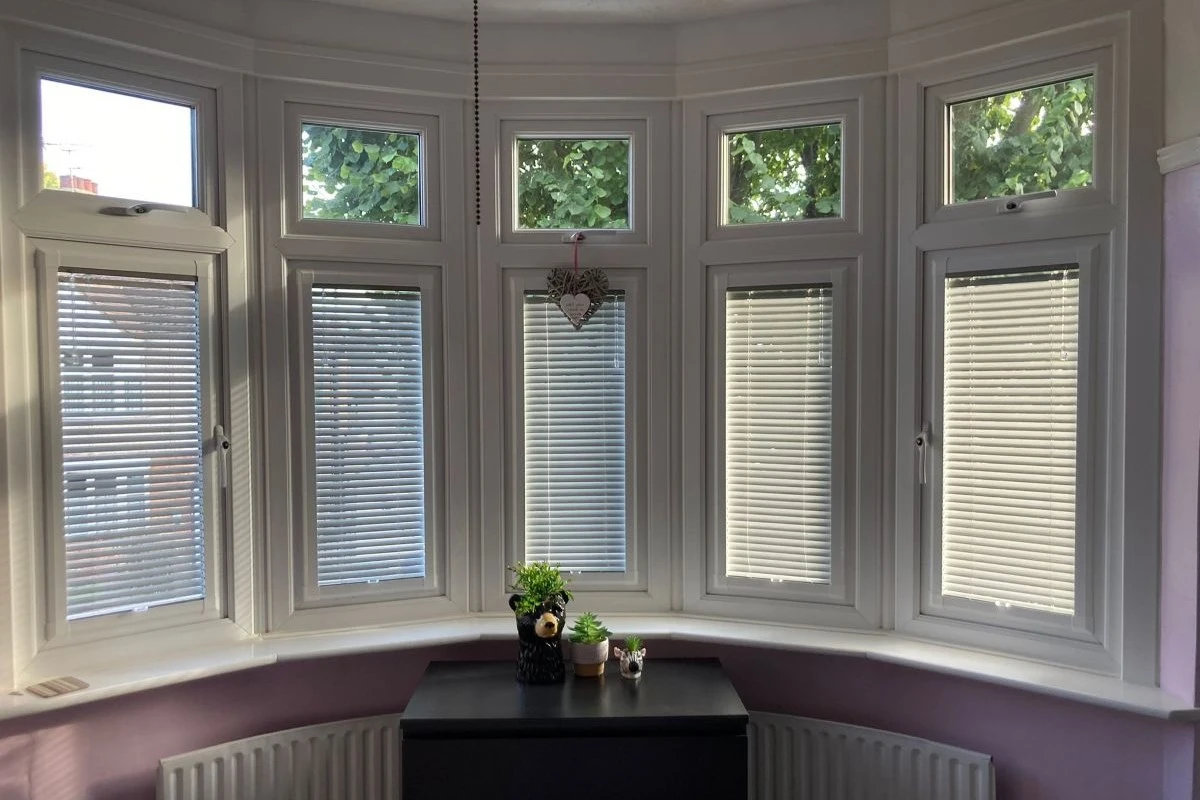
Perfect Fit / No-Drill Blinds
Perfect Fit blinds can be suitable for certain uPVC bay windows, particularly where the bay is made up of individual opening windows with sufficient frame depth.
Because Perfect Fit systems clip directly into the window frame, they could be limited by the window construction and maybe not suitable for all bay types, especially curved or irregular bays.
Strengths:
No drilling required
Moves with the window when opening and closing
Neat, integrated appearance
Suitable for tilt-and-turn or inward-opening windows
Limitations:
Only suitable for specific uPVC window types
Not suitable for curved or irregular bay windows
Limited by frame depth and construction
Less flexibility compared to fully bespoke solutions
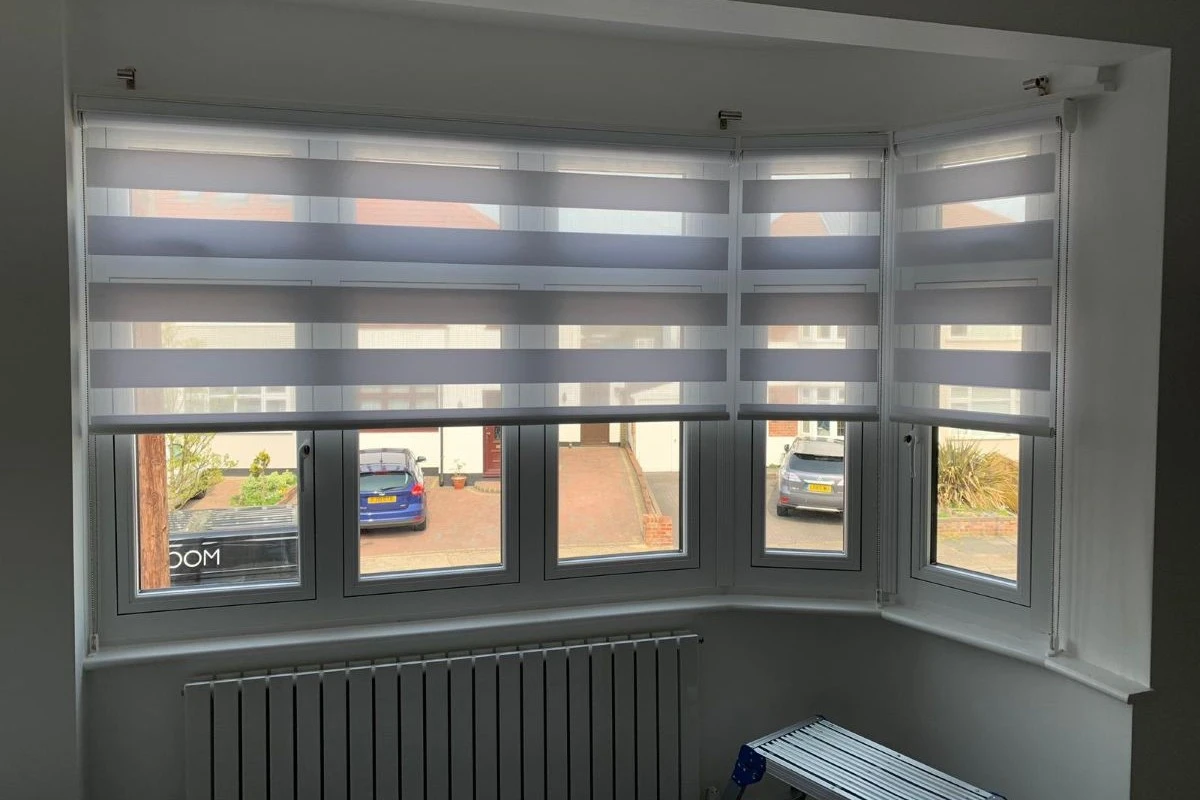
Day & Night Blinds
Day & Night blinds can sometimes be used in bay windows, but their deeper headrails and layered fabric design mean they require ample recess depth and careful planning.
They are best suited to simpler bay layouts and may not be practical in tighter bays or where clean corner alignment is important.
Strengths:
Flexible control of light and privacy
Contemporary appearance
Available in a wide range of colours and finishes
Limitations:
Deeper headrails require sufficient recess depth
Not suitable for all bay window layouts
Alignment between sections can be difficult in angular bays
Less forgiving where precise corner joins are needed
Practical Takeaway – Choosing the Right Window Covering for Your Bay Window
Bay windows are a standout feature in many homes, but they require more thought than standard flat windows when it comes to choosing the right window coverings.
The most successful solutions are those that work with the shape of the bay, rather than cutting across it. Treating each section of the bay correctly helps maintain light, privacy and balance, while avoiding common issues such as gaps, awkward operation or coverings that feel out of proportion.
No single product suits every bay window. The best choice depends on the type of bay, the depth and angles involved, and how the room is used day to day. Roman blinds, Venetian blinds, shutters, curtains and curved vertical blinds can all work well in the right circumstances, while other options may be more limited by the bay layout.
Understanding the structure of your bay window first makes it much easier to narrow down the options and avoid choosing a product that looks good in isolation but doesn’t perform as expected in everyday use.
A considered, well-planned approach ensures your bay window remains a feature of the room, rather than a problem to work around.
FAQs about Bay Window Blinds, Curtains & Shutters
Bay windows work best with window coverings that follow the shape of the bay rather than cutting across it. Popular options include Roman blinds, Venetian blinds, plantation shutters, curtains on shaped tracks and curved vertical blinds.
The right choice depends on the type of bay, available depth and how you want light and privacy to work day to day.
Venetian blinds and plantation shutters are particularly effective, as they allow you to control privacy while still letting daylight filter in.
Curtains can also provide excellent evening privacy, especially when layered over blinds or shutters.
Yes. Curtains are one of the most forgiving and flexible options for bay windows when installed on a shaped or bay track. They follow the angles or curves of the bay and add warmth, softness and insulation.
Curved bay windows usually require specialist solutions. Curved vertical blinds and curtains on shaped tracks are often the most practical options, as many rigid blind systems cannot follow a continuous curve.
Perfect Fit blinds can work in certain uPVC bay windows, particularly where the bay is made up of individual opening windows with suitable frame depth.
They maybe suitable for curved or irregular bay windows if installing on each individual window. Will depend on your bay type.
Bay windows are less forgiving than flat windows, and accurate measuring is especially important. Angles, curves and corner clearances all need to be considered to avoid gaps, clashes or poor operation.
Professional measuring helps ensure window coverings fit correctly and perform as intended.
Yes. Layering is very common in bay windows. Blinds or shutters often handle daytime light control, while curtains add softness, insulation and privacy in the evenings.
This approach allows you to balance practicality with a finished, decorative look.
If you have any other questions, please call us on 01268 949255 and our team will be happy to help.
Need Advice on the Right Window Dressings for Your Bay Windows?
Share a few details below and our team will offer clear, practical guidance based on your bay window layout, light levels, privacy needs and how the space is used day to day.